Introduction: Managing Complex Telecom Field Operations
Managing field operations across a complex telecom environment remains a persistent challenge for operators worldwide. This spans wireline and wireless domains, as well as outdoor and indoor deployments. Field operations cover a wide range of activities, including:
- Milestone tracking
- Workforce management
- Validation of design and as-built documentation
- Quality monitoring and audits
- Compliance reporting
- Vendor performance management
- Billing reconciliation against completed work
- Adherence to health and safety standards
This operational complexity demands transparent, real-time collaboration between back-office teams and field crews. Such collaboration helps operators:
- Optimise resource utilisation and costs
- Minimise site revisits
- Improve service quality
- Accelerate deployment timelines
|
Key Challenges in Telecom Field Operations
|
Streamlining Field Operations
TCTS addresses these challenges through its Neo Automata™ offering for field service management.
Key features include:
| Project Progress Management | Assign, track, and validate milestones with approval workflows |
| Project Documentation | Capture photos, videos, checklists, and as-built artefacts at source |
| Health, Safety, and Site Hygiene | Enforce compliance with safety and protection protocols |
| Workforce Management | Schedule jobs, track execution, and optimise field resources |
| Field Quality Management | Enable remote inspections and consistent quality validation |
| Material and Spare Inventory Management | Track material usage and control inventory accurately |
| 3D Scanning and Modelling | Generate precise measurements for faster, more accurate builds |
| GIS Workflow Navigator | Import GIS designs via KML, KMZ, and AutoCAD files for map visualization |
| AI-Driven Quality and HSW Inspections | AI-assisted validation supports quality inspection and enables acceptance or rejection of jobs |
| Vendor Governance and Billing | Track vendor performance, work volume and quality, and trigger finance for invoicing and payments |
Functional Architecture: Neo Automata™ Field Service Management
The figure below illustrates the functional architecture and interrelated modules of the TCTS Neo Automata™ Field Service Management platform. At its core, an AI/ML engine addresses innovative use cases such as document validation through computer vision, quality inspections and site audits, and health and safety compliance.
Integrated workflow management and vendor governance capabilities enable end-to-end field job assignment, execution tracking, and vendor invoicing. The platform integrates seamlessly with enterprise systems including BSS, CRM, Planning, GIS, Billing, and SAP Finance, delivering unified value across field operations.
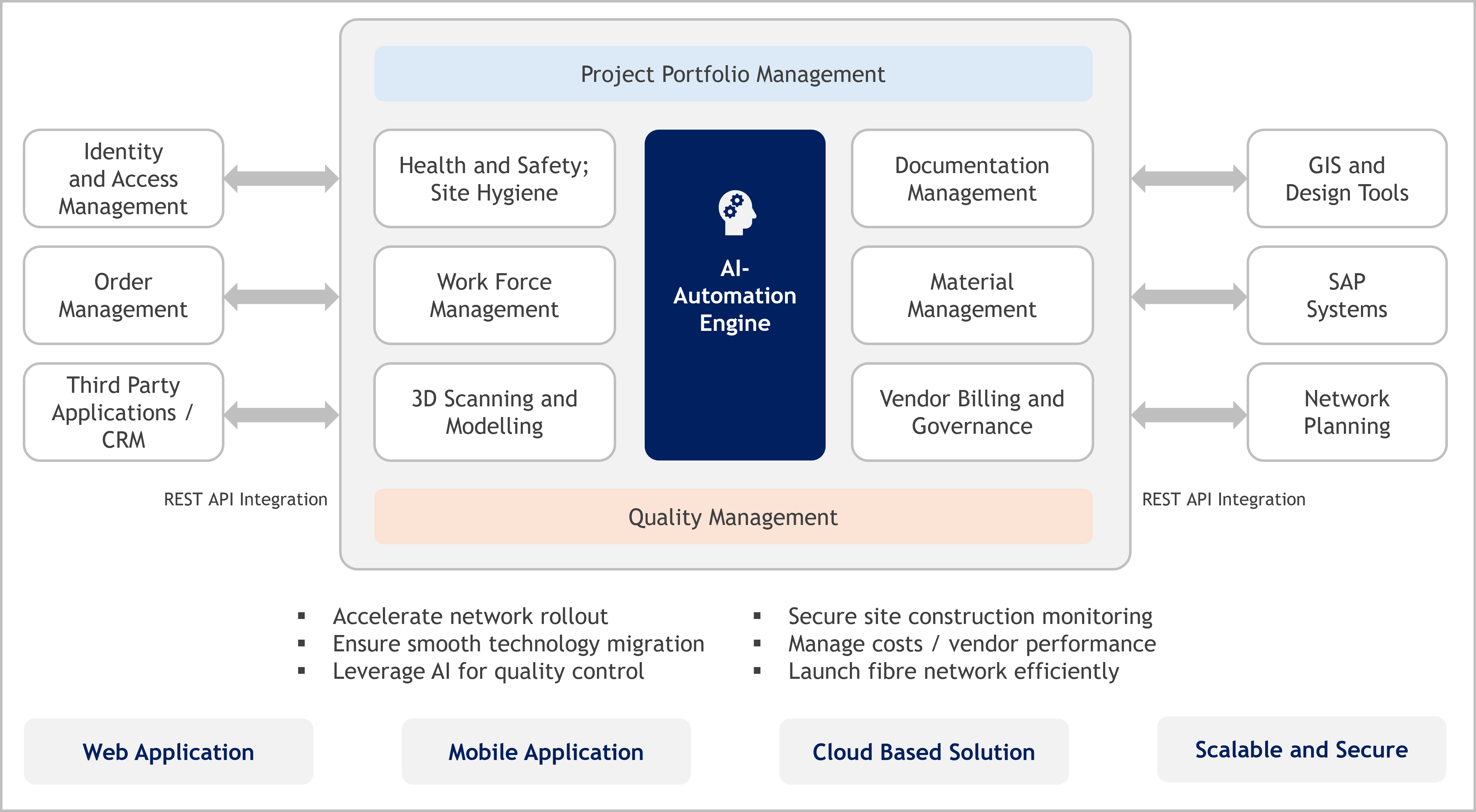
Fig. Functional architecture – Neo Automata™ Field Service Management
Solution Approach
This scenario demonstrates end-to-end field service management for construction work – trenching for fibre roll out.
- A new project is created in the PPM module with defined milestones and tasks for fibre trenching. This includes vendor selection and initiation of a purchase order request through SAP.
- The job is assigned to the vendor through the WFM mobile app. AI validates health and safety compliance and performs site quality inspection.
- The field vendor executes the work, including soil excavation, trenching, and ducting. Supporting artefacts, as-built drawings, and documentation are uploaded to the platform.
- The platform runs AI-driven quality validation and flags non-compliance. The vendor receives a real-time alert to fix issues and restore compliance.
- After job completion, the system automates BOM-to-invoice verification through SAP Finance integration, ensuring accurate, compliant, and leakage-free vendor billing.
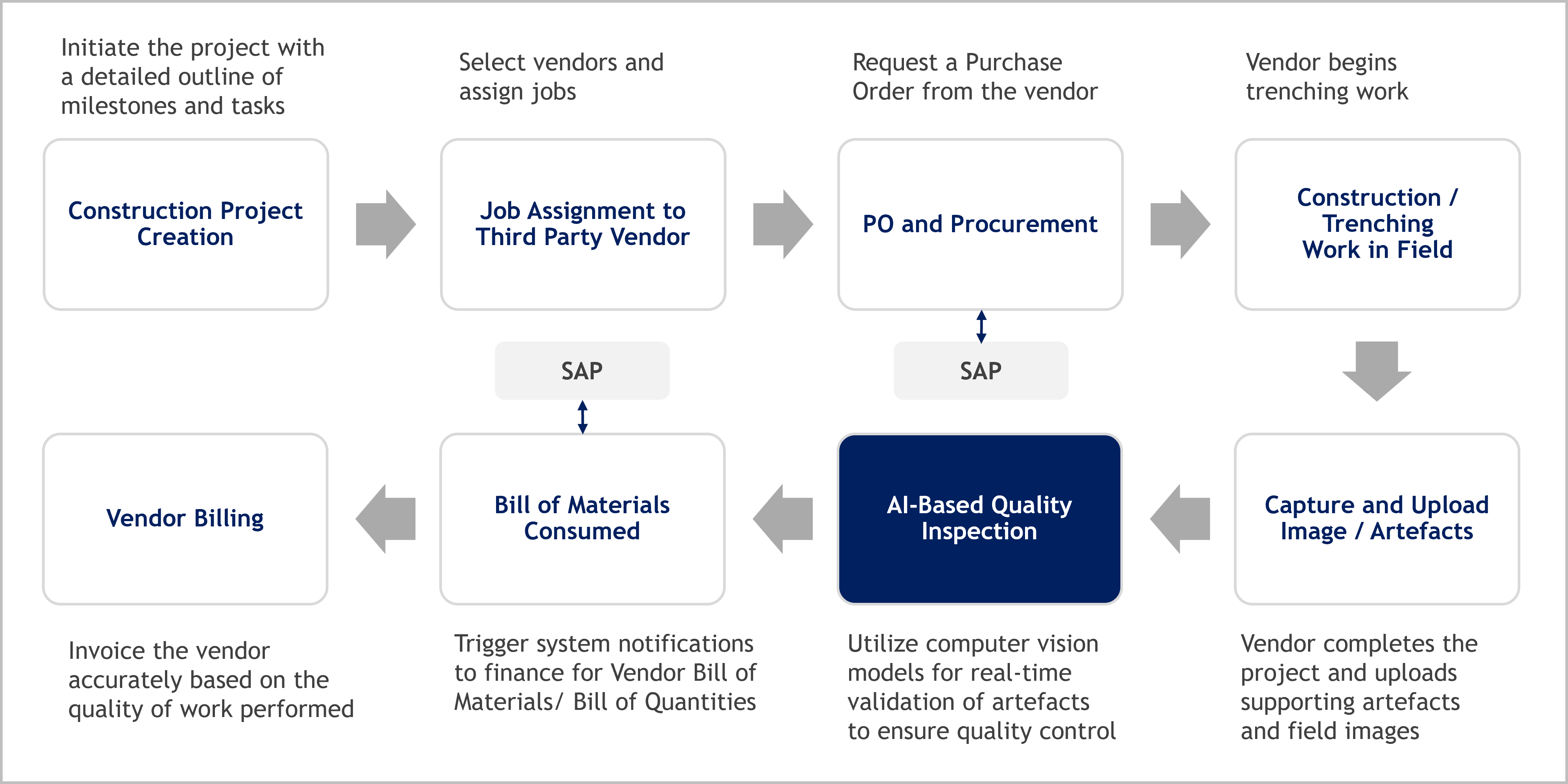
Fig. The end-to-end workflow of field construction with AI-based quality inspection and vendor billing
Business Impact
The AI-enabled field service management solution delivers measurable outcomes across project efficiency, cost control, and field execution quality. It ensures compliance with health and safety standards, supports an effective and smooth roll-out of construction projects, enables accurate milestone tracking, and provides holistic visibility across field operations.
| 30% improvement in project timelines |
10x faster as-built document generation |
6x reduction in repeat site visits |
99% accuracy in AI-assisted HSW audits |
| 10x reduction in cost and revenue leakage from third‑party vendors |
|||