Introduction
In modern telecom operations, a unified inventory management system is a critical enabler of intelligent, automated service assurance. Advanced assurance functions such as service-aware alarm correlation, automated ticket creation, and AI-driven root cause analysis rely fundamentally on accurate, real-time inventory data that provides a complete network and service context.
As networks scale in complexity across the wireline, wireless, access, aggregation, and core domains, operators require a unified inventory that delivers a single, trusted view of the continuously evolving network topology and dependencies.
By harmonising resource, topology, and service data across domains, the inventory system enables assurance platforms to precisely correlate alarms, understand service impact, and trigger auto-diagnosis and remediation workflows using agentic AI.
Tight integration between inventory and assurance allows faults to be detected earlier, tickets to be automatically generated with full context, root causes to be identified faster, and resolutions to be executed with minimal manual intervention. A mature OSS leverages this inventory-assurance convergence to significantly reduce MTTR, prevent fault escalations, and deliver a consistently superior customer experience.
This approach is aligned with TM Forum’s Autonomous Network Level 4 operations, enabling service fulfilment and assurance with minimal human intervention.
|
Key challenges operators face today in service delivery and network operations
|
Unified Inventory and Cognitive NOC: A Single Source of Truth for Planning, Operations, and Assurance
TCTS Neo Automata™ IMS & Cognitive NOC solution addresses these challenges through its AI-powered, zero-touch network automation framework, streamlining order planning, design, execution, assurance, and incident management.
Key features include:
| Order Entry (Resource assign and design) | Assign and track milestones and approve or reject documented field work |
| Automated route selection | Perform A-end and Z-end routing, hop-by-hop, last-mile and carrier selection |
| Configuration and provisioning | Auto-provision component-by-component using orchestrator for ZTP (zero-touch provisioning) |
| Topology visualisation | View complete circuit routing through an end-to-end graphical topology |
| Assurance integration | Maintain data consistency for seamless service assurance |
| Automated ticketing | Create and enrich incidents automatically for faster root-cause analysis |
| Agentic AI-based network automation | Achieve autonomy (AN Level 4) through agentic AI-based diagnosis and remediation |
Functional Architecture: Seamlessly Integrating Inventory, Provisioning, and Assurance
The figure below illustrates the end-to-end functional architecture, covering discovery, order entry, resource allocation, service design, topology visualisation, network provisioning, and integration with the network (EMS/NMS), all managed by an orchestration engine.
Seamless integration with the Cognitive NOC extends the architecture into service assurance, encompassing fault management, AI-driven alarm correlation, automated incident creation and enrichment, and closed-loop auto-remediation enabled by the agentic AI-based Network Automation Platform (NAP).
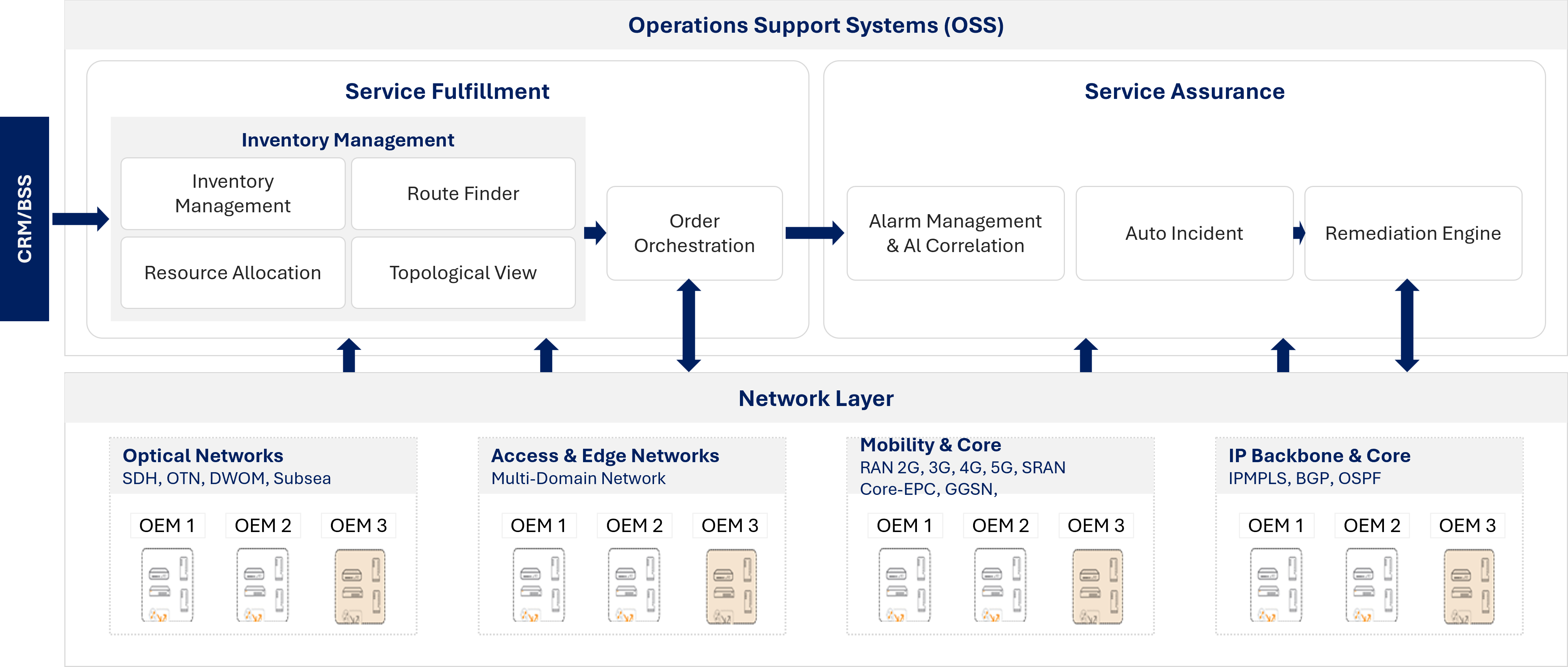
Fig. Functional Architecture – TCTS Neo Automata™ Inventory Management & Cognitive NOC Platform
End-to-End Approach to Implementing ZTP and Zero Touch Assurance (AN Level 4)
The scenario demonstrates an end-to-end order provisioning and assurance workflow aligned with TM Forum AN Level 4 operations in a telco environment.
The flow begins with new service order creation in the inventory system, followed by resource assignment and service design, including an end-to-end circuit topology view and real network provisioning through the orchestration engine.
The solution integrates with the Cognitive NOC for fault management, enabling AI-based alarm correlation, automated ticketing and enrichment, and auto-remediation through agentic AI.
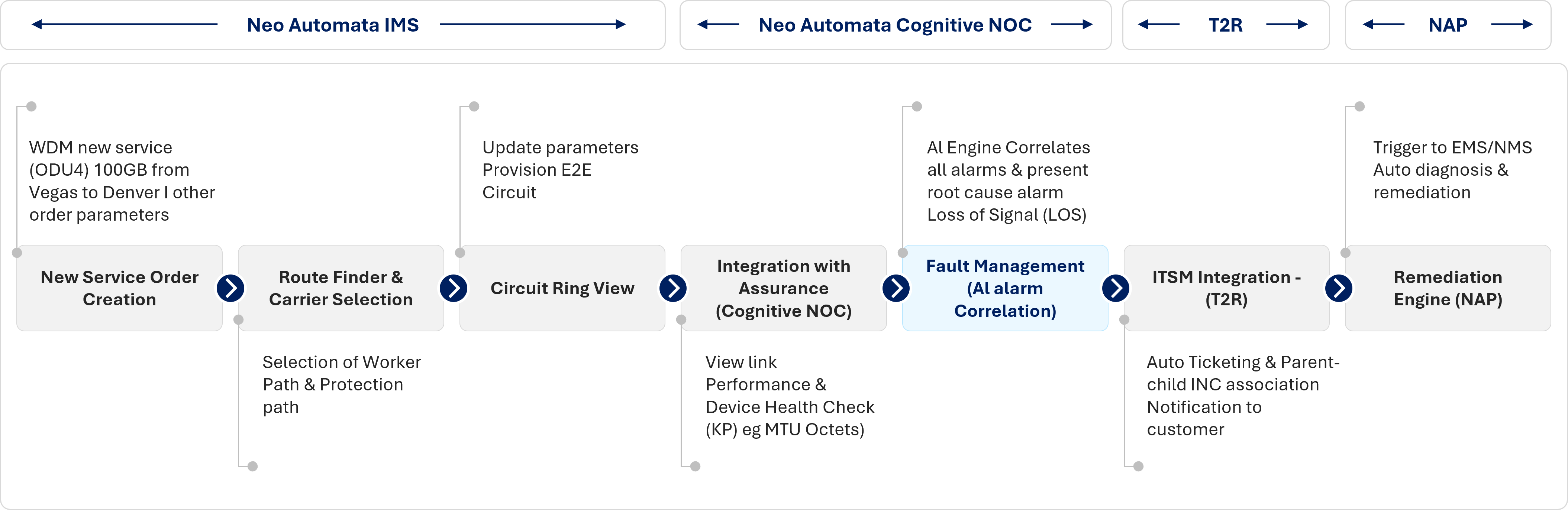
Fig. End-to-end Workflow of Service Order Creation, Provisioning and Assurance
- A new service order (for example, WDM) is created in the IMS Order Management module. Route discovery and resource allocation follow, covering devices, physical and logical paths, and bandwidth assignment.
- The system designs the circuit within IMS and presents an end-to-end topological view, detailing devices, links, paths, bandwidth, and associated working and protection routes.
- After successful provisioning, the order integrates with the Cognitive NOC platform, where real-time alarms are monitored. AI-driven alarm correlation identifies the parent or root-cause alarm.
- An incident is then auto-created in the integrated ITSM system with contextual enrichment. Using agentic AI, the system performs automated diagnosis and remediation in the live network.
Solution Benefits
The solution delivers measurable benefits across the order provisioning and assurance lifecycle by reducing fulfilment and provisioning hand-offs, eliminating human error, and accelerating provisioning through system-based triggers.
Through integration with the inventory, the solution enables real-time root cause analysis (RCA), supporting faster mean time to detect (MTTD) and mean time to repair (MTTR).
| 99% accuracy through real time network discovery |
35% faster order to provisioning cycles |
30% improvement in alarm correlation effectiveness |
25% reduction in MTTR |